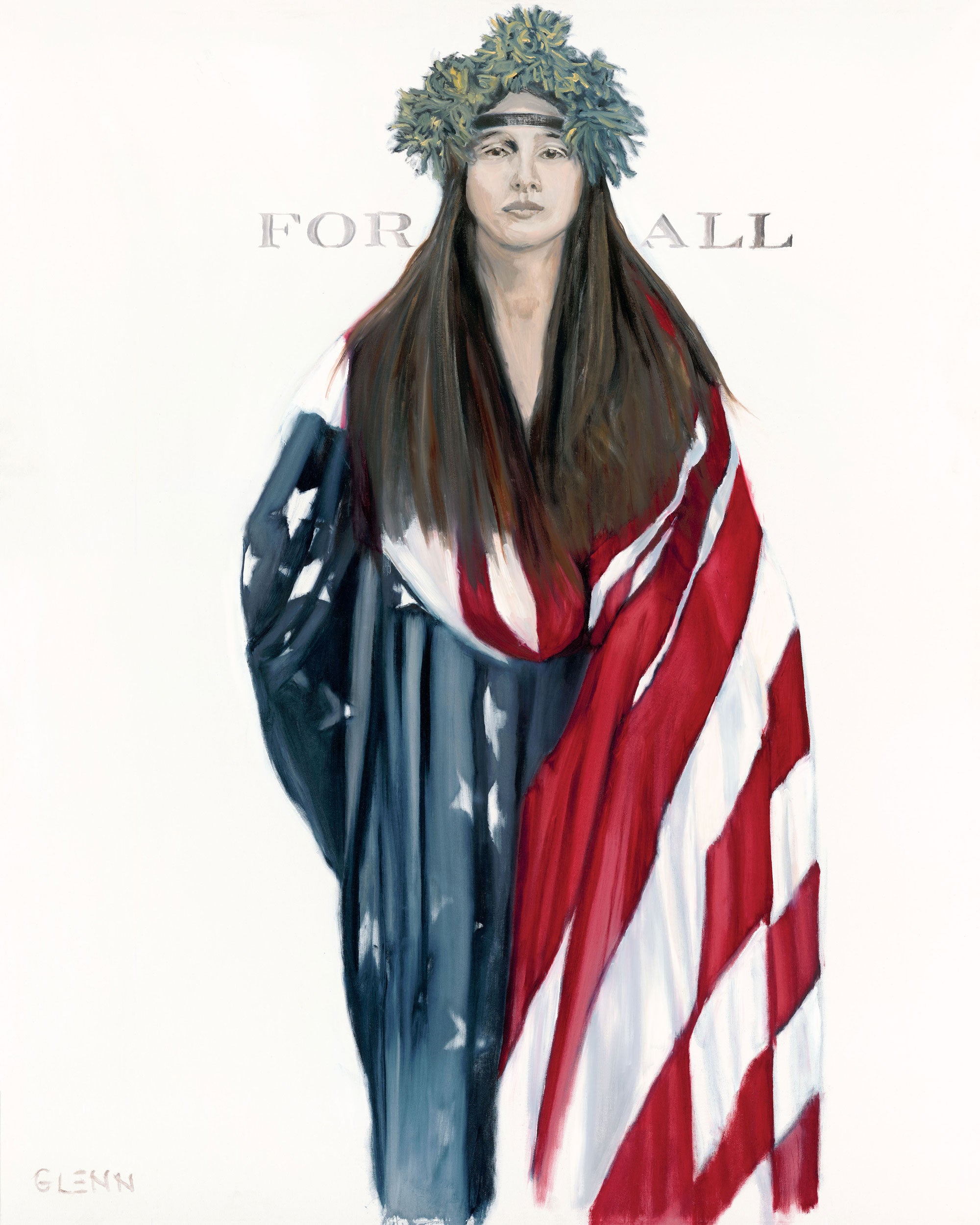
The "Columbia Spirit of Liberty & Justice" is interesting and I understand the sentiment you may be trying to convey. Still, as someone who has fought for this flag, I was disappointed and troubled by its depiction: a woman appears to be wearing the U.S. flag loosely draped around her like an unkept bathrobe.
To me, that presentation diminishes the dignity and meaning of the flag. Moreover, it conflicts with the standards of respect set out in 4 U.S.C. § 8, particularly the provision stating that the flag should never be used as "wearing apparel, bedding, or drapery."
For clarity, I am including the text of 4 U.S.C. § 8 below:
No disrespect should be shown to the flag of the United States of America; the flag should not be dipped to any person or thing. Regimental colors, State flags, and organization or institutional flags are to be dipped as a mark of honor.
a. The flag should never be displayed with the union down, except as a signal of dire distress in instances of extreme danger to life or property.
b. The flag should never touch anything beneath it, such as the ground, the floor, water, or merchandise.
c. The flag should never be carried flat or horizontally, but always aloft and free, except as may be necessary in limited circumstances and done in a respectful manner as part of a military or patriotic observance.
d. The flag should never be used as wearing apparel, bedding, or drapery. It should never be festooned, drawn back, nor up, in folds, but always allowed to fall free. Bunting of blue, white, and red, always arranged with the blue above, the white in the middle, and the red below, should be used for covering a speaker’s desk, draping the front of the platform, and for decoration in general.
e. The flag should never be fastened, displayed, used, or stored in such a manner as to permit it to be easily torn, soiled, or damaged in any way.
f. The flag should never be used as a covering for a ceiling.
g. The flag should never have placed upon it, nor on any part of it, nor attached to it any mark, insignia, letter, word, figure, design, picture, or drawing of any nature.
h. The flag should never be used as a receptacle for receiving, holding, carrying, or delivering anything.
i. The flag should never be used for advertising purposes in any manner whatsoever. It should not be embroidered on such articles as cushions or handkerchiefs and the like, printed or otherwise impressed on paper napkins or boxes or anything that is designed for temporary use and discard. Advertising signs should not be fastened to a staff or halyard from which the flag is flown.
j. No part of the flag should ever be used as a costume or athletic uniform. However, a flag patch may be affixed to the uniform of military personnel, firemen, policemen, and members of patriotic organizations. The flag represents a living country and is itself considered a living thing. Therefore, the lapel flag pin being a replica, should be worn on the left lapel near the heart.
k. The flag, when it is in such condition that it is no longer a fitting emblem for display, should be destroyed in a dignified way, preferably by burning.
The Flag Code also addresses the solemn use of a flag to drape or cover a casket for Soldiers and those who've served this country. Under 4 U.S.C. § 7(n), when the flag is used for that purpose, "the union [is] at the head and over the left shoulder," and the flag is kept smooth, tight, and dignified.
I recognize that artwork can be open to interpretation and that your intentions may have been respectful. But from the perspective of someone who served, using the flag as an article of clothing—even symbolically—does not honor what it represents. I hope you will reconsider the image and the message it sends to veterans, service members, and families who regard the flag as far more than a visual motif.
Respectfully,
Branden Clark